EXPANDING POSSIBILITIES
  • Home
  • ABOUT
    • OVERVIEW
    • PEOPLE
    • CONTACT
  • ACTIVITIES
    • AN EMERGING BOOK >
      • 0. INTRODUCTION
      • 1. MANIFESTO
      • 2. 12 THESES
      • 3. THE AGE OF MACHINES
      • 4. DEATH TO THE DEMON
      • 5. A LARGE WORLD
      • 6. MECHANISTIC MAPS
      • 7. CHURCH-TURING-DEUTSCH
      • 8. THE LOST NARRATIVE
      • 9. WHAT IT IS LIKE TO BE A SCIENTIST
      • 10. EPISTEMIC CUTS
      • 11. THE ART OF MODELLING
      • 12. THE WORLD IS NOT A SET
      • A1: NATURAL PHILOSOPHY
      • A2: DOES IT COMPUTE?
      • A3: SOME WORDS ABOUT SET THEORY
      • A4: LIMITATIONS OF MATHEMATICAL MODELLING
      • A5: WHAT IS CATEGORY THEORY?
    • PEER-REVIEWED PUBLICATIONS
    • PRESENTATIONS
    • ONLINE ESSAYS
    • ONLINE DISCUSSIONS
    • PODCASTS
    • OUTREACH
  • EVENTS
    • FINAL WORKSHOP
    • OUTREACH - rewilding (exhibition)
    • OUTREACH - intangible (exhibition)
    • OUTREACH - dialogführung
    • OUTREACH - open studio #3
    • OUTREACH - landmachine (exhibition)
    • OUTREACH - open studio #2
    • OUTREACH - lecture performance
    • INTERNAL WORKSHOP
    • OUTREACH - open studio #1
    • OUTREACH - performance
  • QUICK THOUGHTS

QUICK THOUGHTS

An experimental micro-blogging format to showcase our process of doing research in real time...
News and events regarding the project will be reported here.


Blog entries will be raw snapshots, not polished and finished products.

Neither will there be full articles here, only links to more detailed work published elsewhere.

Discussion and engagement are encouraged, but comments will require approval.
Nexus Zone

11/22/2024

0 Comments

 
Picture
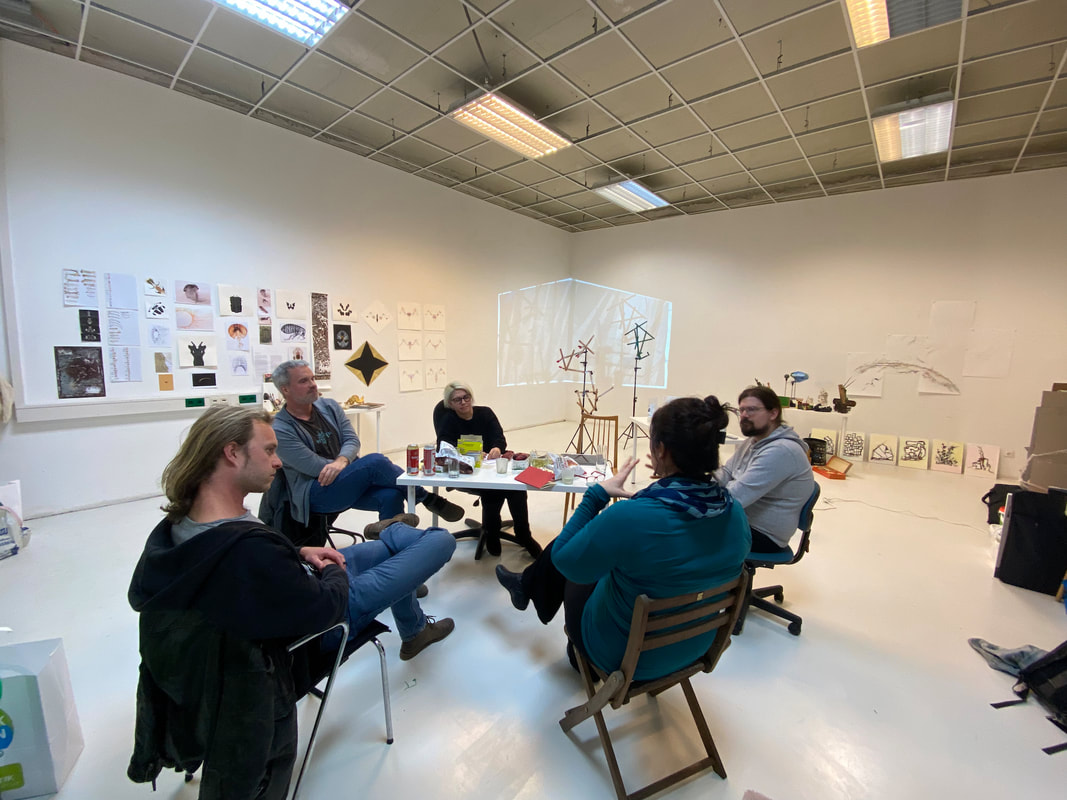
On November 22nd, we had the pleasure of hosting nexus_art + science with The ZoNE in the studio of Bronwyn Lace and Marcus Neustetter. The presentations and conversations dived deep into the world of our current research and experiences in the interfaces between art and science. nexus_art + science, Bronwyn Lace, BASAK SENOVA, Marcus Neustetter and Johannes Jaeger shared their experiences and work and the studio was finally activated by a live studio process by Lace and Neustetter . 
Picture
Picture
0 Comments

Workshops in Worldbuilding - Galemo Montessori School Klosterneuburg

11/19/2024

0 Comments

 
(Yogi)
Picture
Marcus and Yogi designed and facilitated two workshops for high-school kids on how humans get to know their world. These workshops took place at Galemo Montessori School in Klosterneuburg, near Vienna.
The basic idea of our workshops is to ask the participating students to build a world around a small personal item that they bring to the course.
The resulting small portable world are used as the basis for a discussion about what is and what is not under our own control in our lives. As a second part of the workshop, we bring our individual world together with those that others around us have created.
In the end, we learn how we build our own world as we go through our lives, and how those worlds do (or do not) connect with other living beings around us.
These workshops are the beginning of a practice-oriented methodology for teaching high-schoolers the difference between the ways in which living and non-living beings get to know the world and each other.
0 Comments

Epistemic Cuts

11/7/2024

0 Comments

 
(Yogi)
New chapter out! Number10 of "Beyond the Age of Machines:" "Epistemic Cuts" talks about the most fundamental distinction we need to make in order to make sense of our world — the one between self and ambience — and how to bridge that cut with a physics of symbols.
0 Comments

The Age of Machines (Animated Short)

11/4/2024

0 Comments

 
(Yogi)
Our latest short video is out! This one is a teaser for chapter 3 of "Beyond the Age of Machines."
0 Comments

What it is like to be a scientist...

10/18/2024

0 Comments

 
(Yogi)
Picture
Good things take time: at long last, here is chapter 9 of "Beyond the Age of Machines," a fat and central chunk of argument called "What it is like to be a scientist."
Picture
0 Comments

Our Manifesto & 12 Theses

10/11/2024

0 Comments

 
(Yogi)
Our manifesto for "Beyond the Age of Machines" is now out on video!
Full text here.
And we've also made a short video of the 12 Theses behind the book.
0 Comments

Death to the Demon!

10/6/2024

0 Comments

 
(Marcus & Yogi)

This is the beginning of a big project: we plan to produce a short animated video, and a full lecture, for each of the emerging chapters of our book, "Beyond the Age of Machines."
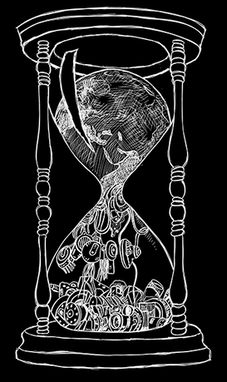
To keep with the nonlinear structure of the book, we start with Chapter 4., "Death to the Demon," It introduces the idea of certain knowledge in a deterministic world, in the form of Laplace's Demon, and it argues why this Demon must be killed and buried, once and for all.
Above is the link to the short animated video, below the full lecture.
0 Comments

Philosophicum in Lech - Kevin wins Essay Prize!

9/28/2024

0 Comments

 
(Kevin)
At the 27th Philosophicum in Lech, themed “Sand in the Gears, Philosophy of Disruption,” ("Sand im Getriebe, Philosophie der Störung"), 650 attendees were immersed in a contemplative environment amid the serene alpine landscapes of the Lechtal. The event combined philosophical depth with the stunning backdrop of nature, engaging participants with a dense program of discussions, lectures, and intimate seminars.
The conference featured poignant narratives and sharp debates. The first disruption was climate activist Anja Windl’s passionate plea for environmental action. An intervention of a kind which, however, seemed to fade away soon without deeper stimulation. The sessions included outstanding presentations from Esther Kinsky and Lambert Wiesing, with Kinsky
exploring the “Poetics of Unrest” through a mesmerizing reading, while Wiesing took attendees on a philosophical adventure from skepticism through Dada to postmodernism and back.


This year’s event was also significant for the awarding of essay prizes to twenty participants, a distinction I was honored to receive, allowing me the opportunity to partake in this enriching experience.

The Philosophicum proved to be not just an academic gathering but a dynamic community event, where discussions stretched into the night, fostering deep connections and lively exchanges among attendees. The conference concluded with reflections on the fleeting yet profound impact of these philosophical engagements.
0 Comments

Pushing the Boundaries — Discussion Sessions: Daniel S. Brooks

9/25/2024

0 Comments

 
(Yogi)
As part of our outreach program, we organize a series of public online discussion sessions with philosophers, biologists, and other researchers who do work that is relevant to our own project. The format is that of a short introductory presentation by our guests, followed by a panel discussion and a Q&A session involving the whole audience.
:[L]evels of organization can be thought of as local maxima of regularity and predictability in the phase space of alternate modes of organization of matter."

This discussion, with philosopher Dan Brooks, revolves around the intriguing quote above (from Bill Wimsatt’s “Re-Engineering Philosophy for Limited Beings"). The idea that there are levels of organization in our experienced reality is one of the most recognizable concepts in the life, neuro, and social sciences. At the same time, the concept is overloaded, and often used in vague or inconsistent ways, which has led some philosophers to argue that we should do away with it altogether. We talk to Dan about why levels are essential for contemporary biology and philosophy of science, and what is meant exactly by “local maxima of regularity and predictability in the organization of matter.”

Daniel S. Brooks is currently a visiting Professor for Theoretical Philosophy at the University of Wuppertal. His research interests span the history and philosophy of the life sciences (particularly developmental biology, ecology and neuroscience), concept usage in science, naturalized epistemology, methodology in philosophy, and existentialism. He has been advocating a new take on levels organization which will appear in a monograph which is (tentatively) entitled “The Leveled World: The Role of Levels of Organization in Biological Thought.”
Book: "Levels of Organization in the Biological Sciences" (with James DiFrisco & William C. Wimsatt)
0 Comments

WISSENSKUNST - Open Studio and Lecture Performance

9/21/2024

0 Comments

 
(Marcus & Yogi)
Yogi, together with artist Bronwyn Lace of the ZoNE, gave a performance lecture during our open studio event on Sep 21, 2024, at the Creative Cluster in Vienna (5. District). We talk about our outreach activities, Wissenskunst, the ontology of the undefinable, magical realism, and our notion of what is real, and how to make our own worlds a reality.
(image credits: Başak Şenova and Hilde Janssens)
0 Comments

Pushing the Boundaries — Discussion Sessions: Hasok Chang

9/18/2024

0 Comments

 
(Yogi)
As part of our outreach program, we organize a series of public online discussion sessions with philosophers, biologists, and other researchers who do work that is relevant to our own project. The format is that of a short introductory presentation by our guests, followed by a panel discussion and a Q&A session involving the whole audience.
In this first installment of our online discussions, we talk with Hasok Chang about his latest book "Realism for Realistic People." It aims to outline a philosophy of science focused on understanding and promoting the actual practices of inquiry in science and other knowledge-focused areas of life, while rejecting the traditional notion of metaphysical realism, which claims that our theories correspond to some ultimate reality. Instead, Chang proposes an “activist realism,” offering a novel pragmatist conception of truth and reality as operational ideals, achievable through actual scientific practice.
Hasok Chang is the Hans Rausing Professor of History and Philosophy of Science at Cambridge University. His research interests lie in the history and philosophy of chemistry and physics from the 18th century onward, as well as the philosophy of scientific practice. He also engages with a variety of topics in the philosophy of science, including realism, pluralism, pragmatism, measurement, and evidence.
0 Comments

THE ZoNE - agitating the space between art and science (conference presentation)

9/13/2024

0 Comments

 
​The ZonE - agitating the space between art and science
by Marcus Neustetter
presented at the
37th Annual South African Visual Arts Historians Conference,
12-14 September 2024
​hosted at the: Department of Visual Arts in the School of Visual and Performing Arts, Faculty of Humanities, Nelson Mandela University, Gqeberha, South Africa Theme: UNSETTLED: re-Collective Memories and Histories of South Africa


0 Comments

Ars Electronica

9/7/2024

0 Comments

 
(Kevin/Paul)
During our visit to the Ars Electronica Festival 2024 in Linz, Paul and Kevin explored a variety of innovative technologies. We interacted with an AI-powered vacuum cleaner and experienced music driven by double oscillators. The exhibition showcased diverse AI art and offered insights into artistic interpretations through technology. Highlights included an extensive display on scientific evolution and a simple yet captivating exhibit of mechanically flying silver fish. Additionally, we attended a talk by Anil Seth on creativity, which provided profound insights into the creative processes influenced by technological advancements.
0 Comments

LANDMASCHINE - Schloss Lind

8/24/2024

0 Comments

 
(Marcus & Yogi)
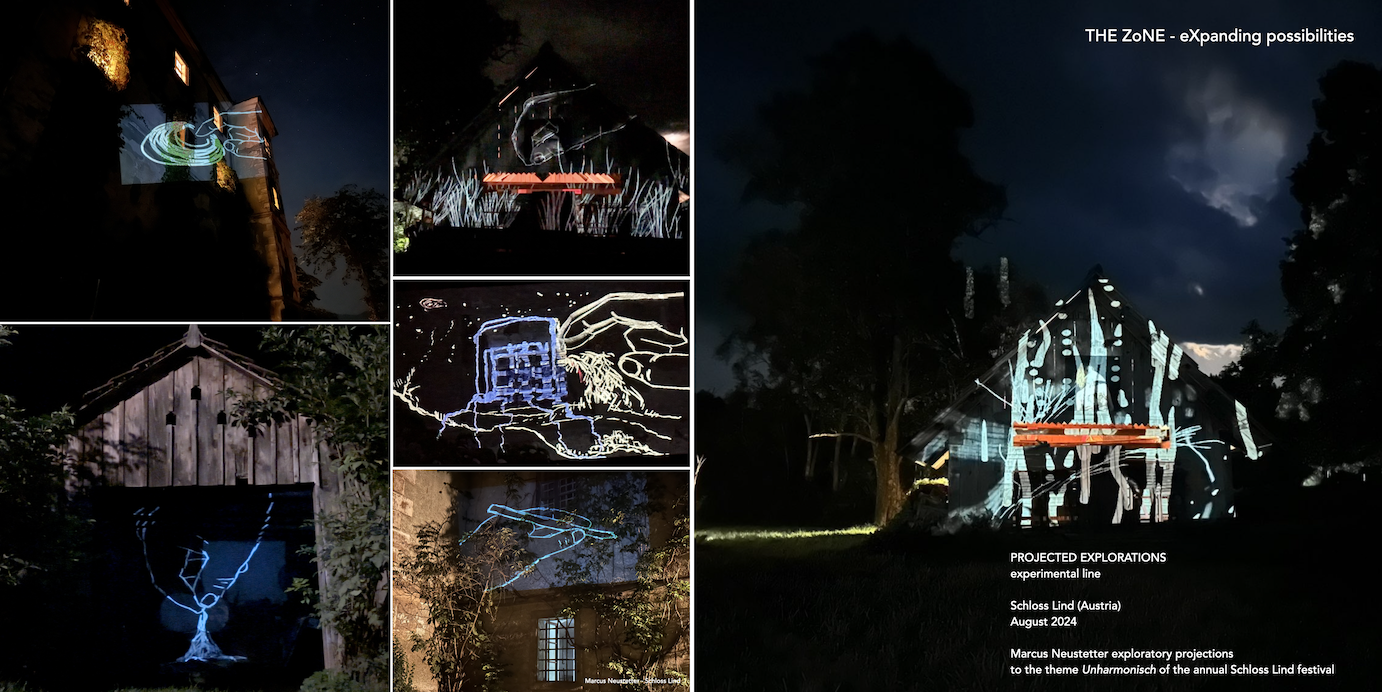
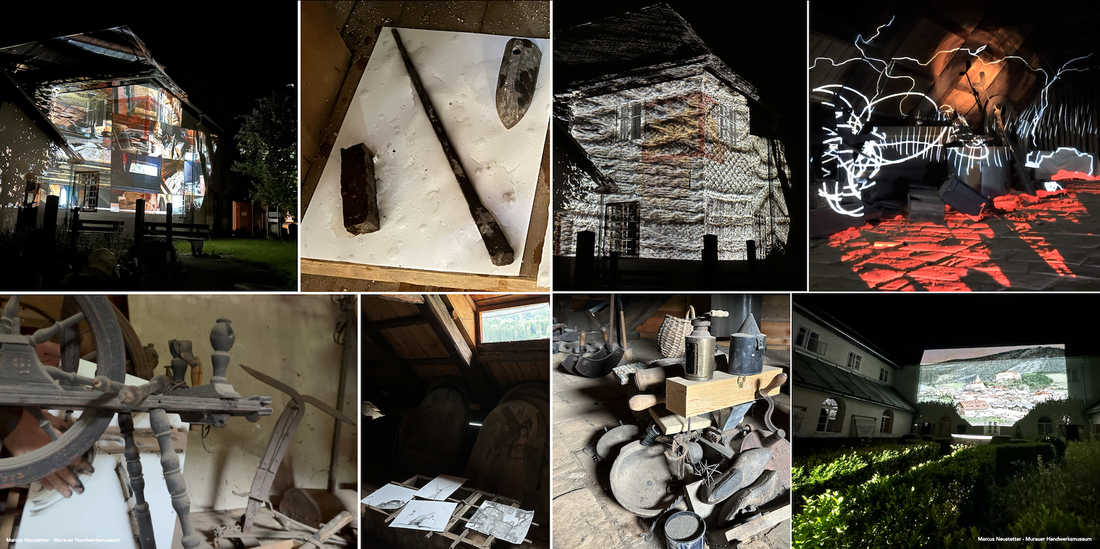
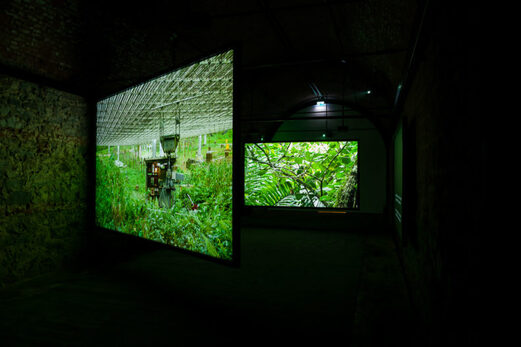
As part of our outreach activities, we were commissioned (through the arts & science collective The ZoNE), to contribute to the event called "Landmaschine" ("land machine") at Schloss Lind, a museum for art and local history in Styria, Austria, where we will also have an exhibition next year.
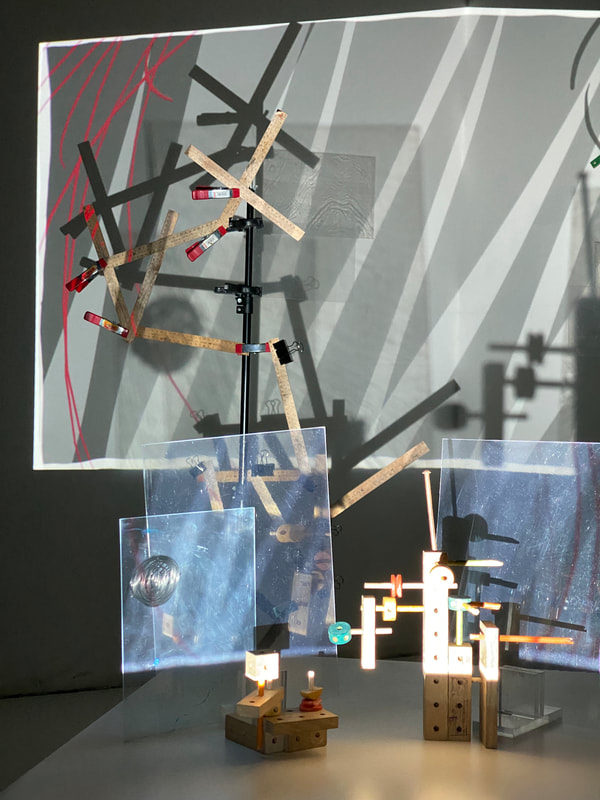
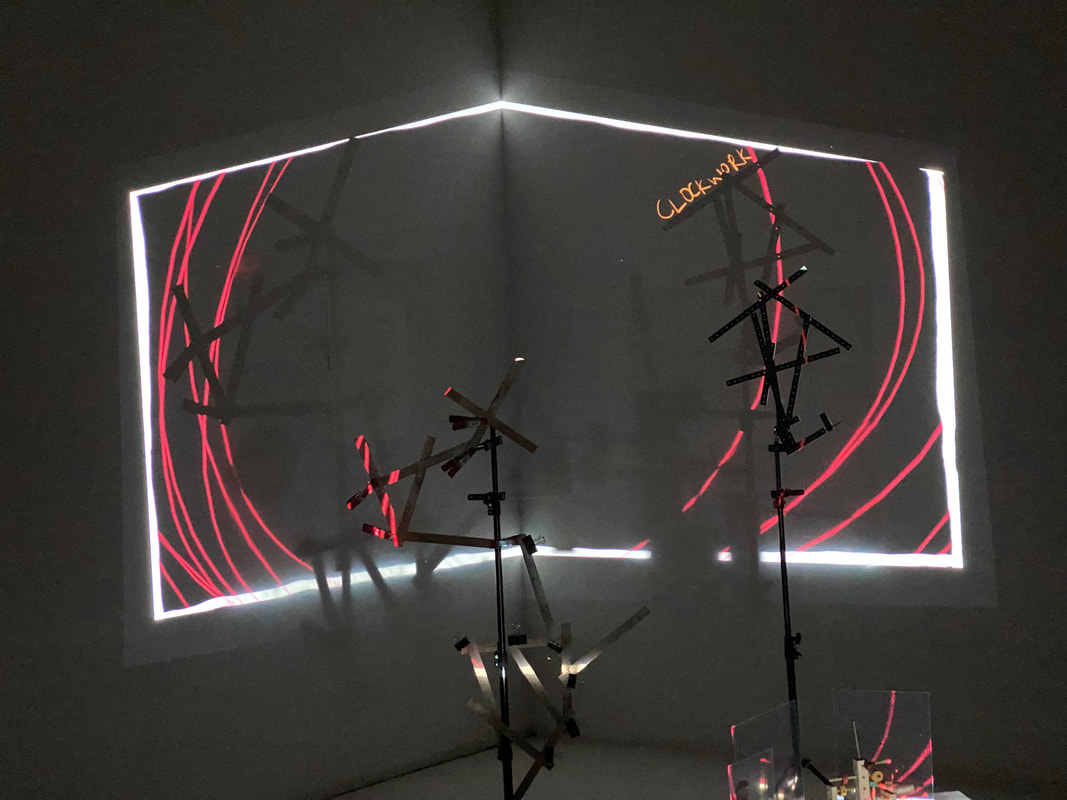
Our activities at the Schloss can be subdivided into three parts: (1) a projection display (of project-related videos, among other animated elements) on the front facade of the castle, plus (2/3) two installations in the former sheep stable on the domain (one on each side of the building), which we used to address the problem of looking at the world as a machine (the theme of our book, "Beyond the Age of Machines"). These installations juxtapose and integrate technology and mechanisms with the natural processes of the castle garden, and the local insect life attracted by our projections. Parts of the installation remain over winter, exposed to the weather, to be revisited and reactivated next year during our exhibition. Actions such as these are powerful interventions demonstrating our philosophical and scientific approach in applied settings, to audiences not usually exposed to academic presentations or scientific research of the abstract kind we are engaged in.
Artwork by Marcus Neustetter and Bronwyn Lace.
0 Comments

Toward a Metamodern Science

8/16/2024

0 Comments

 
(Yogi)
Picture
Yogi just published an essay on metamodern science. Metamodern is what comes after postmodernism: a science that acknowledges our embeddedness in a reality that is bigger than our minds, but also acknowledges that our knowledge is always perspectival, situated in our particular personal, social, and historical circumstances. Metamodern science is process-oriented and pluralist, without falling into intellectual traps like panpsychism or pancomputationalism. Metamodern science is fully aware of its roots in individual human experience. It is pragmatic and useful, adapative, and ever-changing, yet rigorous and robust. Metamodern science is the future of science.
0 Comments

The Organic and the Normative

8/2/2024

0 Comments

 
(Yogi)
Picture
From Jul 29 to Aug 1, Yogi traveled to beautiful Ljubljana in Slovenia, to give a talk called "Organizational Continuity as the Basic Norm for Living Systems" at a workshop entitled "The Organic and the Normative", which was organized by Sebastjan Vörös, Ela Praznik, and Timotej Prosen.
Picture
Picture
Picture
Picture

The workshop included speakers such as Arantza Etxeberria, Xavier Barandiaran, Charles T. Wolfe, Andreas Weber, and also fellow group member Mortiz Kriegleder.
Yogi's talk focused around Rosen's concept of immanent causation and the idea of organizational continuity (first proposed by DiFrisco and Mossio) as a naturalist and materialist foundation for the emergence of norms in self-manufacturing (autopoietic) systems. This is the core of an argument that Yogi plans to write up as a collaborative paper with biochemist Jannie Hofmeyr. His talk stirred some controversy through his remark that contemporary (heavily computationalist) biology understands life less than ever before in human history...
0 Comments

zOOm ZoNE: ArtScience - with Dr. Ulrike Kuchner

7/7/2024

0 Comments

 
(Yogi)
Picture
We have a new zOOm ZoNE podcast out! Bronwyn, Marcus, and Yogi talk to the wonderful Dr. Ulrike Kuchner, co-founder and main initiator of the ARTlab Nottingham, and member of the SEADS (Space Ecologies Art and Design), about the importance and role of ArtScience collaborations in today's crazy world in crisis. We discuss a wide range of topics, such as how to fundamentally change our habits of thinking, how to deal with existing institutions in arts and science, and why thinking out of the box is so important for understanding the universe as a whole.
Check it out on the ZoNE YouTube Channel, by clicking here.
0 Comments

Adventures among ideas: Agency, Algorithms, Art, and Bullshit

6/26/2024

0 Comments

 
(Yogi)
Yogi talks to David Dennen and Daniel Tarpy as part of their YouTube podcast series "Adventures Among Ideas." We cover a wide range of topics, including: why philosophy should be important to biology, how our ideas affect the world we live in, the differences between living systems and algorithm-based systems, Michael Levin's "Technological Approach to Mind Everywhere," and the importance of art.
0 Comments

Naturalizing Relevance Realization

6/25/2024

0 Comments

 
(Yogi)
Picture
The paper "Naturalizing relevance realization: why agency and cognition are fundamentally not computational," which Yogi co-authored with Anna Riedl, Alex Djedovic, John Vervaeke, and Denis Walsh, has just been published after peer-review in Frontiers in Psychology (Section Cognition). It is the biggest and most important output of our project so far, challenging a number of fundamental assumptions in cognitive neuroscience, evolutionary biology, artificial intelligence, and the philosophy of mind. The main thesis is that cognition rests on the realization of relevance in the environment of a living, autopoietic system: picking out what is important to oneself, and what is not. All living beings, from bacteria to humans, can do this, but machines cannot, because this process is fundamentally not algorithmic. Instead, it is an adaptive (meliorative) evolutionary dynamic, that occurs through the continuous co-emergent construction of new constraints. This kind of dialectic process occurs across levels or organization, integrating autopoiesis, anticipation, and adaptation in organismic behavior and its evolution. Here's the abstract:
Picture
Or go an read the full version here.
0 Comments

Andrea: various presentations during the summer ...

6/18/2024

0 Comments

 
(Andrea)
Picture
Andrea gave a talk in Paris (co-authored with Tarja Knuuttila and Max Noichl) on "The Kuramoto Model: Biography of a Model Template," plus a different version of the same talk on Jun 20 at the Institute for Quantum Optics and Quantum Information in Vienna.

... and other one, entitled "On Machine Learning-generated representational artifacts" (with Rona Aviram and Max Noichl) on Jun 18 at the LSE in London.

0 Comments

The Lost Narrative

6/18/2024

0 Comments

 
(Yogi)
We have a new chapter out for "Beyond the Age of Machines:" it's called "The Lost Narrative."
It is an interlude and bridge from our criticism of the machine view of the world (Part I), to the outline of the pragmatist perspectival philosophy of science we've come to call our own (Part II of the book).
0 Comments

Ontogenesis, Organisation, and Organismal Agency

5/10/2024

0 Comments

 
(Yogi)
Picture
Picture
It's always a long wait until book chapters are finally officially released... This one was first published as a preprint in June, 2022, and is now finally available as part of Jana Švorcová's edited book on "Organismal Agency."
In this essay, Yogi examines the connections (if any) between theoretical research on organismal agency and experimental work in cell and developmental biology. There are three main insights: (1) the two fields of investigation are only indirectly connected, through the fact that both agency and the overall constraints that act on physiology and development are grounded in the self-manufacturing organization of the organism; (2) these global constraints, which are required to maintain organizational continuity and are a prerequisite for life and its evolution, put strict limits on the form that ontogenetic processes can take (and their understanding is therefore necessary if we are to understand the nature of such processes), and (3) in multicellular development, agency comes into play through the behavior of individual cells as units of organismal ontogenesis.
This lays the foundation for research within our project, which examines the limits of current experimental and modeling practices in biology, and potential methodologies to transcend those limits.
0 Comments

Exploring Possibility Spaces in Zürich

5/9/2024

0 Comments

 
(Andrea)
Picture
Picture
Picture
Picture
From May 5-9, 2024, Andrea visited the research group of evolutionary systems biologists Andreas Wagner at the University of Zürich to discuss the various way in which possibility
spaces are conceived, constructed and modeled by the members of the group. What are biologically accessible possibilities and how are they explored by evolution? Are such possibilities predefined or do they evolve in time? How do structures in the genotype space constrain and generate phenotypes? And how does the space of possibilities relate to evolutionary fitness landscapes? These are some of the questions we discussed by looking at specific topics such as multicellularity, constructing fitness landscapes, and mapping genotypes to phenotypes. One of the most interesting observations of this visit was how interested practicing biologists can be in conceptual questions such as the meaning of robustness and innovation in the context of evolutionary biology, and how these concepts become instantiated through model construction and modeling. It has been an intellectual treat spending a week in this group and the plan is to have these visits on a more regular basis.

0 Comments

The first part of the book is done!

5/5/2024

0 Comments

 
(Yogi)
Picture
Yogi is really excited to announce that he has finished the first part (out of four) of his book called "Beyond the Age of Machines." You can read all the chapters he's already written on this project website here.
Part One is a thorough reevaluation of the machine view of the world, and especially its latest guise: the idea that the world is some kind of computer, or that all physical processes perform some kind of computation. Yogi highlights the metaphysical baggage of this view, which is not a rational view of the world based on science "all the way down." Instead, it is based on some rather dubious decisions that need to be understood in their particular historical context. This baggage now unduly constrains and limits the questions we can ask, and the explanations we accept in contemporary science. This criticism lays the groundwork for our own proposition how to go beyond these limitations.
All of the chapters will be illustrated by Marcus. He has not quite caught up to Yogi yet, but will do so over the next few weeks so it's worth checking in regularly, also because Part Two is about to be added. This second stage of the book will introduce the philosophy of scientific perspectivism to the reader, which we will then use in Parts Three and Four to build our theory of the organism, and the corresponding epistemology for a science of the 21st century.
Picture
0 Comments

Church-Turing-Deutsch

4/28/2024

0 Comments

 
(Yogi)
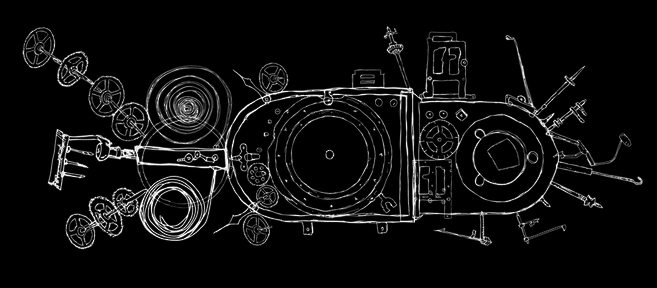
"Church-Turing-Deutsch" is the meatiest chapter in "Beyond the Age of Machines" so far. It concludes part I (of IV): a comprehensive criticism of the machine view of the world, from the clockwork universe to modern (pan)computationalism.
0 Comments
<<Previous
Forward>>
Powered by Create your own unique website with customizable templates.
  • Home
  • ABOUT
    • OVERVIEW
    • PEOPLE
    • CONTACT
  • ACTIVITIES
    • AN EMERGING BOOK >
      • 0. INTRODUCTION
      • 1. MANIFESTO
      • 2. 12 THESES
      • 3. THE AGE OF MACHINES
      • 4. DEATH TO THE DEMON
      • 5. A LARGE WORLD
      • 6. MECHANISTIC MAPS
      • 7. CHURCH-TURING-DEUTSCH
      • 8. THE LOST NARRATIVE
      • 9. WHAT IT IS LIKE TO BE A SCIENTIST
      • 10. EPISTEMIC CUTS
      • 11. THE ART OF MODELLING
      • 12. THE WORLD IS NOT A SET
      • A1: NATURAL PHILOSOPHY
      • A2: DOES IT COMPUTE?
      • A3: SOME WORDS ABOUT SET THEORY
      • A4: LIMITATIONS OF MATHEMATICAL MODELLING
      • A5: WHAT IS CATEGORY THEORY?
    • PEER-REVIEWED PUBLICATIONS
    • PRESENTATIONS
    • ONLINE ESSAYS
    • ONLINE DISCUSSIONS
    • PODCASTS
    • OUTREACH
  • EVENTS
    • FINAL WORKSHOP
    • OUTREACH - rewilding (exhibition)
    • OUTREACH - intangible (exhibition)
    • OUTREACH - dialogführung
    • OUTREACH - open studio #3
    • OUTREACH - landmachine (exhibition)
    • OUTREACH - open studio #2
    • OUTREACH - lecture performance
    • INTERNAL WORKSHOP
    • OUTREACH - open studio #1
    • OUTREACH - performance
  • QUICK THOUGHTS